
Migration · Shopify → Odoo
Migrate from Shopify to Odoo
Most Shopify stores should keep Shopify and put Odoo behind it. That is the cheaper answer and the one we recommend by default. The move only pays once your Shopify plan plus paid apps clears roughly $400 a month, which is about what the same team costs to run on Odoo. Below that line we will tell you to stay. Above it, migrations start at $5K, run four weeks end to end, and usually pay for themselves inside a year.
Why teams leave Shopify
- A Shopify Plus upgrade is on the table, but the features driving it (B2B price lists, multi-store, checkout logic) are ones Odoo eCommerce already covers
- The app stack behind the store (subscriptions, B2B, ERP connector, tax, loyalty, reviews) costs more per month than the storefront, and each app owns a slice of the customer record
- B2B and wholesale became a real share of revenue, so price tiers, credit limits, and payment terms live in the ERP where the storefront cannot see them
- Manufacturing, kitting, or made-to-order sits behind the catalog, so Shopify stock is a number pushed in from elsewhere and is wrong for hours at a time
- The connector itself became the operational burden: sync failures, duplicate orders, and storefront-to-ledger tax mismatches surfacing at close
- Odoo is already the system of record for inventory, purchasing, and accounting, and the storefront is the last workflow outside it, so every price change is a two-system change
Octura's 6-phase migration playbook
- 01
1. Fit test + app-stack audit
Days 1-3
We run the keep-or-consolidate test first and price your current app stack line by line. A real share of these engagements end here, with a recommendation to keep Shopify and connect Odoo instead. If the numbers do not clear the bar we say so on day three, before anyone has spent build budget.
- 02
2. Catalog + data profiling
Days 3-7
Full export of catalog, customers and order history in the same week. We profile variant depth, option sets and metafields, map Shopify option sets to Odoo attributes, and flag the smart collections whose rules need rebuilding as Odoo domains. Profiling runs against the export, not your live store, so nothing is blocked.
- 03
3. Odoo build: catalog, pricing, checkout
Week 2
Configure Odoo eCommerce, Inventory and Accounting, and build B2B price lists and payment terms if they are in scope. The checkout path is built first because it carries the most conversion risk, and it is held against your Shopify baseline for the rest of the build.
- 04
4. URL map + redirect plan
Week 2-3, in parallel
Runs alongside the build rather than after it, which is what makes four weeks possible. We crawl every indexed product, collection, page and blog URL, preserve Shopify handles where Odoo allows it, and build the 1:1 301 map. Nothing about this workstream depends on the Odoo build being finished.
- 05
5. Dry run, UAT and conversion baseline
Week 3
One full dry run into staging, not two: the data is already profiled and the import scripts were written in week 2. We reconcile order totals, tax and inventory against Shopify reports, and record your current conversion rate by device and traffic source so there is an agreed number to compare against.
- 06
6. Soft launch + cutover
Week 4
Traffic moves to Odoo, redirects go live with the switch, and the sitemap is resubmitted the same day. We watch Search Console and conversion daily for 30 days afterwards against a documented rollback path. The 30 days of hypercare sit outside the four weeks; the migration itself is done.
Data we migrate
- Products, variants, and options, with Shopify option sets mapped to Odoo attributes (SKU, barcode, weight, and cost carried through)
- Collections, both manual and automated, with smart-collection rules rebuilt as Odoo domains
- Product media: images, alt text, and video, rehosted with filenames preserved so image search survives
- Customers with addresses, tags, marketing-consent state, and B2B company-to-contact structure
- Order history (configurable, typically 24 months) with line items, taxes, shipping, fulfillments, refunds, and returns
- Inventory on hand by location, cost basis, and any open purchase orders held in Shopify
- Discount codes, automatic discounts, and gift-card balances (gift cards are flagged early, they usually need re-issue rather than transfer)
- SEO assets: every indexed product, collection, page, and blog URL mapped to a 301, plus meta titles, descriptions, and structured data
Risks & how we mitigate
- Organic traffic dips after cutoverFull crawl before the content freeze, a 1:1 redirect map covering every indexed URL, Shopify handles preserved where Odoo allows it, sitemap resubmitted on launch day, and Search Console watched daily for 30 days against a documented rollback path. Mishandled redirects are the single most expensive mistake in an ecommerce migration.
- Saved payment methods and active subscriptions do not transferCard vaults are tied to the payment processor, not to you. Subscription and repeat-purchase customers need a re-authorization campaign scheduled before cutover, not discovered after it. We scope this in week 1 because it drives the launch calendar.
- Shopify apps with no Odoo equivalentEvery installed app is inventoried during the audit and classified as native Odoo, rebuild, keep external via API, or retire. Anything with no equivalent is decided before the contract is signed, never after go-live.
- Conversion rate regresses on the new checkoutShopify checkout converts well and that is the real cost of leaving. We rebuild the checkout path first, measure it against your recorded baseline, soft-launch a traffic slice where possible, and agree in advance the threshold that triggers a hold.
Four weeks, end to end, and that is the plan we commit to in the SOW rather than a best case. It holds because the redirect map is built in parallel with the Odoo build instead of after it, and because profiling the export means one dry run is enough. Scope changes the size of the team, not the length of the calendar: a larger catalog or a custom theme rebuild adds people, not weeks. The 30 days of hypercare after cutover sit outside the four. We schedule cutover outside peak season and never inside Q4 for retail.
From $5K, set by the complexity of the site you already have. A clean catalog on a standard Odoo theme sits at the low end. Deep variant structures, B2B price lists, multi-currency, or rebuilding a custom Liquid theme like for like push it to $20K-$70K. Scope adds people to the four weeks, it does not add weeks. The return is run cost, not the project. Odoo is $24.90 to $37.40 per user per month plus managed hosting from $250, so a five-person team is about $375 a month. That is the number your Shopify plan and apps have to beat. At $700 a month you save roughly $325 and pay a $5K migration back in about 15 months. At $1,000, around 8 months. At $1,200, closer to 6. Below about $450 a month the saving is too thin to be worth the work, and we will tell you to stay.
Storefronts already running on Odoo
The usual objection to leaving Shopify is that Odoo eCommerce cannot match the storefront. These are live stores built on Odoo's website builder, captured from the sites themselves. They are not Octura clients, they are here so you can judge the output before you judge the platform.
 FairphoneDTC electronics, configurable product pages and a repair-parts catalog, opens in a new tab
 Bonne MamanFMCG brand storefront with recipe content alongside the shop, opens in a new tab
 SakayaJapanese sake boutique, editorial storytelling wrapped around the catalog, opens in a new tab
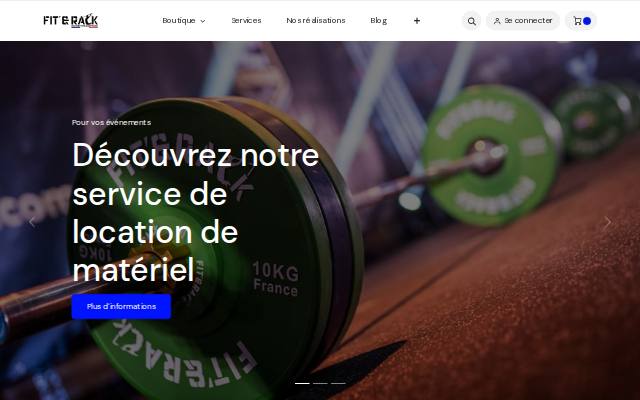 Fit'&RackFitness equipment, deep variant and accessory structure, opens in a new tab
 PermaFungiSmall-batch DTC, the scale most Shopify stores actually are, opens in a new tab
 CaromelaB2B importer selling to trade, price lists and account pricing, opens in a new tab
Ready to scope a Shopify → Odoo migration?
Book a free 30-minute consult. We'll review your Shopify footprint, the modules you actually use, and propose a fixed-fee migration timeline within five business days.
Book a migration consultShopify → Odoo migration FAQ
Should we actually leave Shopify, or keep it and connect Odoo?
For most stores, keep Shopify and run Odoo behind it. Odoo has a native Shopify connector that syncs orders, products, and customers, and running the storefront on Shopify while Odoo handles inventory, accounting, fulfillment, and CRM is a valid intermediate step before a full consolidation. You can also split it, DTC staying on Shopify while B2B runs on Odoo with its own price lists and payment terms. Three things flip the answer to a full move: the paid app stack behind the store costs more than the store itself, B2B pricing rules force a Shopify Plus upgrade you would otherwise skip, or the connector has become the thing that breaks at month end. If none of those apply, we will tell you to stay.
Will we lose our Google rankings when we move off Shopify?
Not if the redirect work is done before cutover rather than after. We crawl every indexed product, collection, page, and blog URL, preserve Shopify handles wherever Odoo allows it, and build a 1:1 301 map for the rest. Expect a short dip in the two to four weeks after launch while Google recrawls, and a return to baseline after that. The failure mode is not migration itself, it is launching without the map and discovering the gaps from a traffic chart.
What happens to saved payment methods and active subscriptions?
Saved cards are held by the payment processor and are tied to the Shopify account, so they do not move with your data. Any store with subscriptions or a meaningful share of repeat customers on saved cards needs a re-authorization campaign planned before cutover. We scope this in the first two weeks because it sets the launch date, and it is the single most common thing teams discover too late.
Can Odoo eCommerce really replace our Shopify apps?
By category: B2B price lists, tax, shipping rules, inventory, and basic loyalty are native in Odoo. Reviews, advanced page building, and subscription billing are either rebuilt as Odoo modules or kept external and connected by API. A handful of niche apps have no equivalent and get retired on purpose. The audit in week 1 classifies every installed app into one of those four buckets, so there are no surprises after go-live.
What does it cost, and when does it pay back?
Migrations start at $5K and are priced on the complexity of the site you already have, reaching $20K to $70K for deep variant structures, B2B price lists, or a custom theme rebuilt like for like. The payback comes from run cost, not from the project. Odoo is $24.90 to $37.40 per user per month plus managed hosting from $250, so a five-person team is about $375 a month. Take your Shopify plan, add every paid app and any extra transaction fee, and subtract that. A store paying $700 a month pays a $5K migration back in roughly 15 months, at $1,000 a month it is about 8 months, and at $1,200 closer to 6. If your total is under about $450 a month the saving is too thin to justify the work, and that is the most common reason we recommend staying on Shopify.
Run the numbers